Chevron is the pattern London keeps asking us for. Here's how it differs from herringbone, which oak colours work in London light, what fitting involves, and what actually drives the price.
What chevron actually is
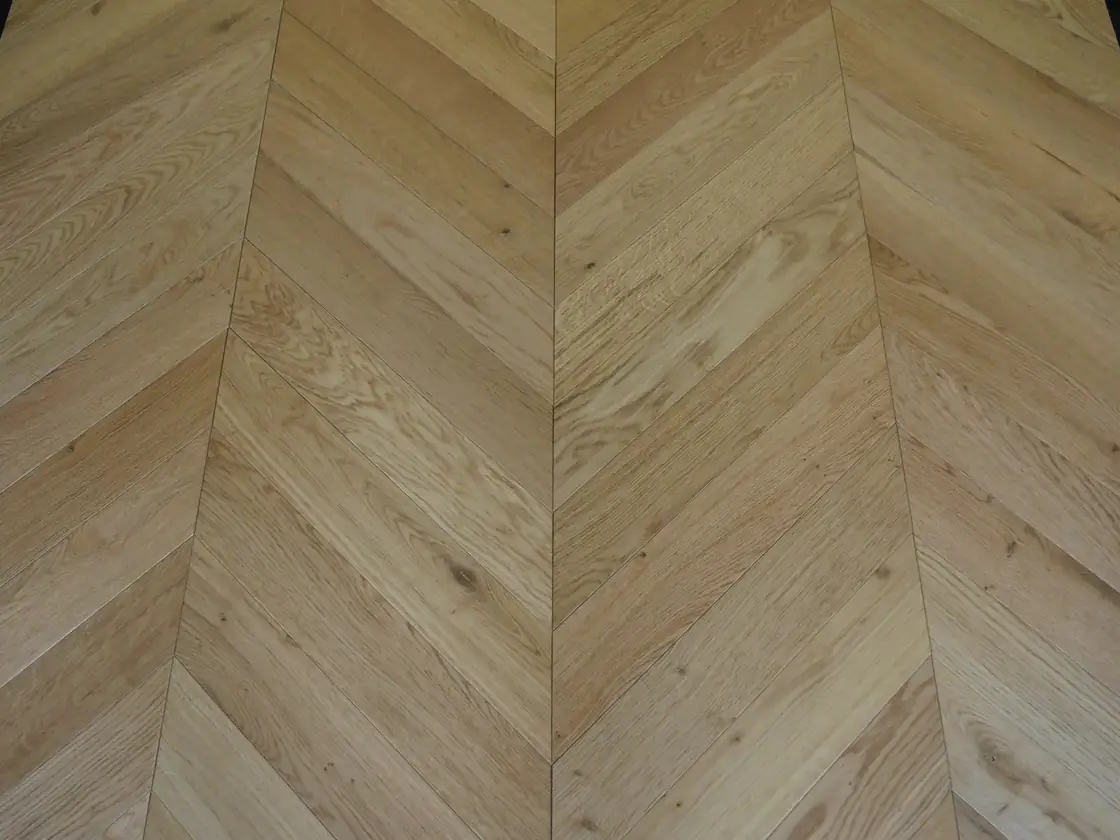
Chevron boards are cut at an angle at each end, usually 45 or 60 degrees, so two rows meet in a clean point and run down the room as a continuous V. Herringbone uses rectangular blocks that overlap in a zigzag. Side by side the difference is obvious: chevron reads as sharp arrows, herringbone as a woven texture.
Because every board is pre-cut to the angle, chevron only works as an engineered floor with a factory profile. You can't make a chevron floor out of standard planks on site. That's also why it arrives with a tongue and groove on all four sides and goes down fast once the first row is right.
Why it suits London homes
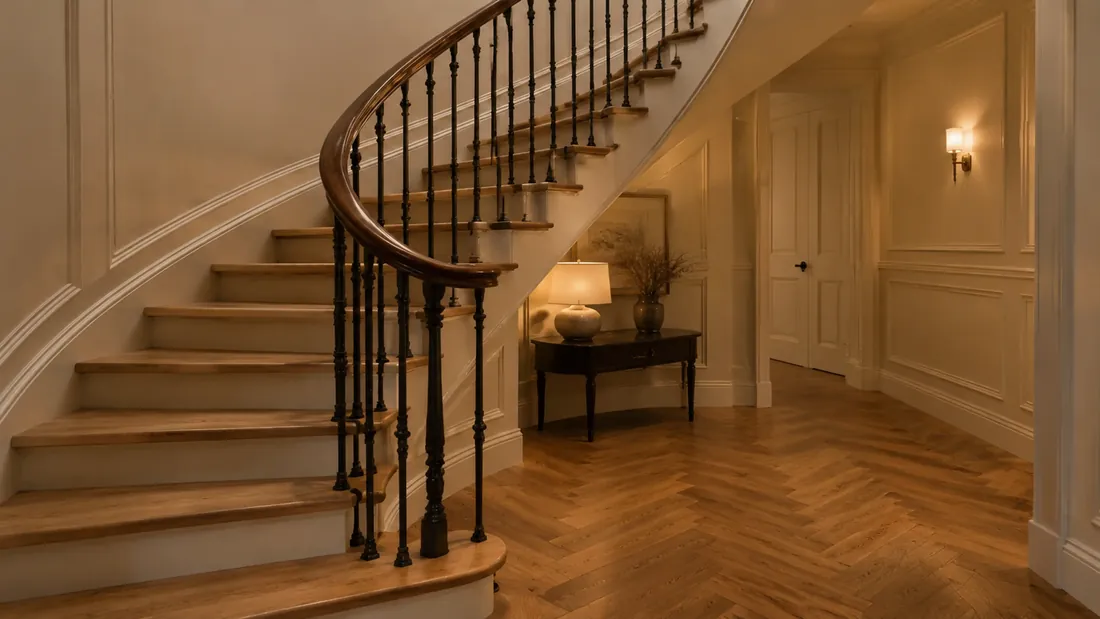
The point of the V draws your eye along its length, which makes a narrow Victorian hallway feel longer and a knocked-through ground floor feel like one deliberate space instead of three rooms with the walls removed. Run the arrows towards the garden doors and the whole floor pulls you through the house.
It also suits the way London is built. Most of the chevron we fit goes over screed or concrete in new-builds and extensions, or over plywood laid on original joists in period terraces. Engineered chevron handles both, and it's stable over underfloor heating, which almost every open-plan refurbishment now has.
- Hallways and landings: run the point away from the front door
- Open-plan kitchen-diners: run towards the garden, not across the room
- Flats: chevron on a quiet acoustic underlay keeps the lease happy
- Period houses: chevron in the reception rooms, plank in the bedrooms is a classic London mix
Which colours work
London light is flat and grey for half the year, so very pale floors can look washed out and very dark ones can swallow a room. The floors we fit most are in the middle: natural oak with a matt finish, invisible oak (a finish that keeps the raw sawn look of unfinished timber), and smoked tones for people who want depth.
Chevron shows colour more than plank because the angled grain catches light from two directions. A floor that looks one shade on a sample can look two shades in a room. That's why we bring full boards, not swatches, to a survey, and lay them where the light actually falls.
Natural Oak Chevron, UV oiled → · Invisible Oak Chevron, matt lacquered → · Rock Grey Chevron, smoked → · Dark Brown Chevron, brushed oiled → · Golden Brandy Chevron →
How a chevron floor is fitted
Everything hangs on the centre line. We snap a line down the room, dry-lay the first two rows against it, check the point is dead square to the longest wall, and only then glue. Get that first row a few millimetres off and the arrows drift across the room; by the far wall it's visible from the door.
Chevron is always fully bonded with a flexible adhesive, never floated. That means the subfloor has to be flat to within about 3mm over 2 metres, dry, and sound. On concrete we test moisture before we order the floor, not after. On old boards we overlay with plywood first. It's the part of the job nobody photographs and it's where cheap chevron installs go wrong.
What drives the price
Three things, in order: the board itself (wear layer thickness, grade and finish), the condition of your subfloor, and the shape of the rooms. Chevron creates more offcuts than plank because every board meets a wall or a doorway at an angle, so we allow more waste on complicated layouts and less on a simple rectangle.
We don't publish a price per square metre because the same pattern can be a very different job in two houses on the same street. Our estimator gives you an honest band in a minute, and a free survey turns that into a fixed written quote within 48 hours. Supply and fit is one price from one team, with a 10-year workmanship guarantee on the fitting.
Questions
Is chevron more expensive than herringbone?
Can chevron go over underfloor heating?
Which direction should the arrows point?
Can you match chevron to a floor I already have?
How long does a chevron installation take?
Updated 2026-10 · 6 min read · by the BAJ Flooring family